
Echoes of the past, and times of change
Former Cardiff West MS and First Minister Mark Drakeford recalls the Ely and Caerau he knew in the 1980s when he first came to the area as a young probation officer.
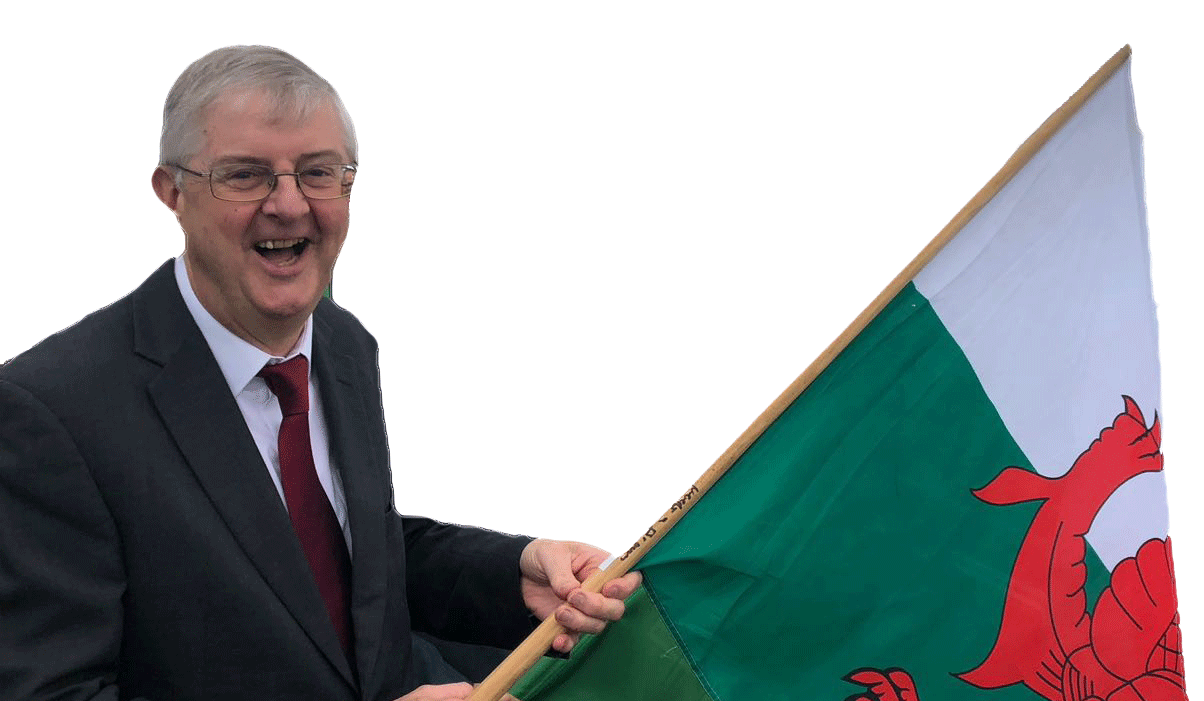
Mark Drakeford waves a flag for the area he represented as a member of the Senedd ...
I first visited Ely for work purposes in September 1979, almost half a century ago. I had been through Ely before that, of course. As a child growing up in Carmarthen, more than sixty miles to the west, a visit to Cardiff was very rare indeed, and only made for exceptional purposes, such as seeing the Sound of Music. But those rare journeys always involved the A48 and its long descent, through St Nicholas and through the estate, along the Cowbridge Road, and towards the city centre.
Truthfully, by the time I arrived as a very young probation officer, I barely knew Cardiff at all. The news that I was to join “West” team meant very little to me, even though that chance decision was to have such an impact on the rest of my life.

Grand Avenue, Ely, in 1970
I want to be clear, at the outset, that none of what follows is written in a spirt of nostalgia. Much has changed in the last fifty years - some of life today is more difficult, but much of it is far better. My aim is to recollect, as accurately as I can, my impressions of Ely life at a period far closer to the end of the second world war, and the creation of the welfare state, than we stand in relation to 1979 today.
Just a few ground clearing points, to start. As I write, today, the news is full of crisis in the criminal justice system, including a chronic shortage of probation officers. That certainly has echoes of the past. My interview, at the old South Glamorgan County Hall on Newport Road, lasted exactly seven minutes. The second question was, “When would you be able to start work?”.
Oil shocks - another contemporary theme - in the 1970s may have meant that Keynsian economics had not worked as well as had been the case in the 1950s and 1960s. But government still, and unambiguously, believed that it had a core responsibility to secure full employment.
Indeed, in the year 1976 the United Kingdom was the most equal country in Europe. The gap between the top and bottom was at its narrowest. The share of national income taken by labour - those who worked for a living - was at its highest since 1945. Conversely, the share taken by capital - those who lived off their accumulated wealth, was at its lowest. Political leadership remained in the hands of the class of 1945, people like Jim Callaghan, Dennis Healey and Barbara Castle - individuals whose shaping experiences had been the hardships of the 1930s and the fight against fascism in the second world war.
"How monolithic it all seemed"
And so, to Ely. The main things which strike me now, from the vantage point of 1979, was how monolithic it all seemed. Practically every house on the estate was owned and rented by the local authority. Men worked at the Ely Paper Mill. Women worked at Ely Hospital. Children attended school at Glan Ely or Glyn Derw (or, in a minority of cases, Mostyn High School for those of the Catholic faith). The huge majority left school at 16 officially, if they stayed the course that long. Black faces were rare, and where they existed, were most often “coloured”, or “mixed race” people (as they were known) who had moved to Ely from within Cardiff itself, rather than coming to the city from elsewhere.
Gender roles were fixed in a way which would be unrecognisable to young families today, with grandparents whose formative years had taken place before or during the second world war. Family patterns, too, were at the tail end of an era which stretched back into the 19th century. I visited many times the Home for the Unmarried Mother and Her Child, on Cowbridge Road. A child born out of wedlock was still, for many families, a fact to be hidden.
Mark with Cardiff academic Howard Williamson who lived in Ely in the 1970s while researching for his PHD on the area.

Reputationally, the estate had the challenges which will be familiar to anyone reading this piece today. Certainly, there were parts which had a concentration of difficulties, caused in part by local authority allocation policies. As I was arriving in the area I met the soon-departing Howard Williamson, today a very distinguished academic, and author of some of the best books ever written about Ely. Then, he was a PhD student who had carried out his research by living on the estate. He produced what was known in policy circles as a “critical patch analysis”, demonstrating that many of the most acute social problems of the estate were concentrated in a small number of adjoining streets - streets which were to become familiar to me over the next ten years.
Physically, the fabric of the estate was mixed. I spent the dark autumn of 1979 driving my red mini up and down the streets for North Ely, armed only with a Cardiff A to Z. Many street names were missing or faded into obscurity. House numbers were invisible from the pavement. In an era in which we were far less aware of personal safety, I would set off from the Probation Office in Westgate Street, equipped only with a single piece of paper which told me to find a fourteen-year-old young man charged with six counts of physical assault. When the house had finally been found I would knock the door. A small person would appear. I would explain why I had called and who I needed to see. “That’s me,” this child would answer - and so the work would begin.
Politically, the estate was equally monolithically Labour. In Ely itself, the outstanding figure was the Reverend Bob Morgan, long-time incumbent at the Church of the Resurrection and leader of the Labour opposition at South Glamorgan Council. The Member of Parliament was the Speaker of the House of Commons, George Thomas, representing the area for Labour, as he had done since 1945. Time after time, as I visited houses on the estate, I would be struck by photos of George (as most people called him) in his full Speaker’s robes, there on the mantelpiece, looking down, apparently benignly, on the conduct of family life.
Everything was about to change
Across Cardiff West, the centre of gravity of the Labour Party was Ely. The local branch was amongst the largest, and it supplied the chair and the secretary of the constituency party. With George Thomas expected to retire as a Member of Parliament before the next General Election, the Party selected Ely Councillor David Seligman as its new candidate.
For most people, their contact with public services came through the health service, and the local authority. These touch points with the state may not always have been amicable, but they were visible. Gas and electricity services were publicly provided and could be reached, respectively, via the Gas and Electricity Board showrooms. The social services department had its offices on the estate. The Housing Office stood centrally on Grand Avenue. Libraries were available in Ely and Caerau, as were youth centres. Ely Police station was situated, symbolically, opposite Crossways Road, sharing a location with the newly built Ely Leisure Centre.
On the surface, at least, the world was stable place
All of that was about to change. Mrs Thatcher’s first election victory had already happened, in March 1979. Although I didn’t know it, my first years in Ely coincided exactly with the last gasps of the certainties which were so apparent: that there would always be a job; that the state would discharge its responsibilities “from the cradle to the grave”, and that your children could look forward to a better future than you had known yourself.
As the dismal decade of the 1980s ground on, all of that came under threat, and some of the fragilities under the surface became more and more apparent.
As those stresses and strains emerged, the importance and limitations of different networks across the community of 30,000 people became more evident. In my experience, at least three were prominent.

Alun Michael - "the moving spirt" and "a bundle of driving energy in the 1980s"
The first was the network of public services, especially those which provided for young people. The moving spirit in all of that was, undoubtedly Alun Michael, the Area Community Tutor, and a bundle of driving energy. He created a series of forums where different services, and more importantly, those who worked in them, came together to share information, and to pool resources.
I said at the start of this piece that my aim has been to look back, as far as possible, without nostalgia. I hope that, with some objectivity, therefore, I can say that this was as effective a network which I experienced in my career. Alun’s midnight phone calls may have been legendary, but they were part of the glue which he had created, and which made me feel, certainly, that I was part of a far wider web of services which could be linked together to help the young people and their families who were part of my responsibility.
The second network was the faith groups which ran across the estate. I’ve mentioned Father Bob as he was known already. But there were many others. Even in 1979, the safety net of the welfare state was fraying. In the ten years which followed it became threadbare to the point where, far too often, it did not exist at all. Those were the times when, as a probation officer, I would contact Bob, or the Reverend Mary Evans, or someone else from Cytun, Churches Together in Ely - because when all else failed, they were still there.
"One of the most remarkable community activists" - Gloria Yates with Mark in 2024. Gloria was also a valued ACE Trustee.

The third was that network of Ely voluntary and third sector organisations which, sometimes below the surface, created connections between its residents. Here, in my experience, women were very often the people who made things happen. Anyone who moved in those circles over decades in Ely would have come under the spell of Gloria Yates, one of the most remarkable community activists of my experience. And I want to end this note by remembering someone else who had a great influence on me - Shirley Collins, long term resident of Snowden Road, and the formidable head of the Citizens Advice Bureau on Caerau Lane.
From the time I arrived at the Cardiff Probation Office, I knew that I didn’t want to spend my time calling young people in to see me in the office. I wanted to see them where they lived - in their own homes, and on the estate where they lived. Quite quickly I established myself every Tuesday afternoon at the CAB office, where I could be found by people who needed to see me, and where I could dash in and out, going to see them. Being at the CAB was to be directly in touch with the problems which faced people in their daily lives, and to see the efforts made by Shirley and her band of volunteers, to help put things right. It sparked my determination to put the political system to work to change the systems which had let people down. It led to my becoming the leader of the Barnardo's community development project in the same premises.
But for now, as they say, all of that will have to be history.

Seeing the work of the Citizens Advice Bureau in Caerau "sparked my determination to put the political system to work to change the systems which let people down".